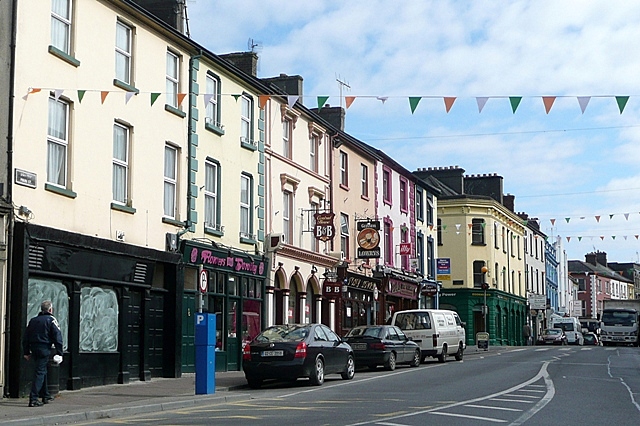
Fethard, Co. Tipperary: A Walk Around Ireland's Medieval Walled Town
A small Tipperary town that still sits inside much of its medieval wall, with a church roof from about 1489.

Fethard, in south Tipperary, is a small market town that still sits inside much of its medieval wall. Several sources, including a local map quoted in The Irish Times, call the wall the most complete of any medieval town in Ireland. You can walk beside long stretches of it, step into a church whose nave roof dates to about 1489, and learn about the town’s horse-breeding story in the old town hall. It is about 16 km east of Cashel.
How the walls came about
Wikipedia says the town was founded in the early 13th century in the Norman period. The first mention of walling is from 1292, when the king allowed levies over seven years for “the inclosing of their vill”. A grant of 1375 specifies stone walls, which suggests that earlier defences were earth and timber. Roaringwater Journal adds that most of the surviving wall was built or rebuilt in the 15th century. Local historian Terry Cunningham, quoted in The Irish Times, says the walls of the 14th and 15th centuries were “definitely not in ruins” when new.
Some sections stand as high as 7.8 metres (26 ft), according to Wikipedia. In the 19th century all but one of the town gates were removed, and only the North Gate survives. The old West Gate at Madam’s Bridge incorporated a three-storey 15th-century tower house, recorded by the antiquarian George Victor du Noyer in the 1850s, and the town also had a Water Gate. Along the river side, Edmund’s Castle and a mural tower known as Fethard Castle punctuate the line of the wall.
Tower houses inside the walls
Fethard is a town of fortified houses as well as walls. Roaringwater Journal describes tower houses standing along the wall and fortified town houses within it, some hidden behind later facades. Court Castle is the obvious example, and Watergate House beside it has the sloping base typical of the 15th century. Look also at the Watergate area, where the same writer found one of Fethard’s two medieval sheela-na-gigs, an unusually gaunt carving.
Holy Trinity church
Just inside the wall is the medieval parish church of Holy Trinity. The Irish Times calls it one of the largest medieval parish churches in the country, with parts dating to the 1200s. Roaringwater Journal describes a 15th-century tower, a nave roof of timber dated to about 1489, one of a small number of medieval roofs to survive in Ireland, and a timber screen to the vestibule. It is still a place of worship, so it is sometimes closed to visitors.
Fethard Horse Country Experience
The visitor centre is in the restored Tholsel, the old town hall on Main Street. Roaringwater Journal describes an audio-visual presentation and display panels upstairs, from which you look down over Holy Trinity and the walls. The wider story it tells is of the horse. Wikipedia notes the town’s economy is tied to the equine industry, and describes it as home to Coolmore Stud and the stables of trainer Michael “Mouse” Morris. The Irish Times says Coolmore is a couple of kilometres from the town and horses have grazed the surrounding fields for centuries.
The friary and the Cromwell story
Wikipedia records an Augustinian friary founded outside the walls at the start of the 14th century, whose west tower was removed in 1835. In 1650 Cromwell’s troops were stationed in an old abbey in the suburbs. Roaringwater Journal says the town surrendered under terms and was spared the destruction seen elsewhere, and repeats the local tradition that Fethard people will not go out the way Cromwell came in, so funerals take a longer route to the cemetery.
Visiting
Walking the town is free. Parts of the wall front private property, and some sections are not open to the public, so stay on public streets and the riverside walk. A section of wall was rebuilt in the early 1990s and shows as a lighter band of stone. Opening times and prices for the Horse Country Experience and for guided heritage tours change, so check with the venue and the local tourism listings before you set out.
From Ardfinnan
Fethard is about 28 km from Ardfinnan, about 30 minutes by road, and Wikipedia gives the distance from Clonmel as roughly 13 km. Ardfinnan is itself a Norman castle on the Suir, seen at its best from the village bridge. Fethard fits easily with Cashel and Cahir in a day, and our roundup of the Castles of Tipperary shows how to join them up.
Frequently asked questions
Are Fethard's medieval walls the best preserved in Ireland?
Several sources describe Fethard as having the most intact, or most complete, set of medieval town walls in Ireland. Wikipedia says that despite some demolition much of the defensive wall remains, and some sections rise to 7.8 metres.
How old are the walls of Fethard?
Wikipedia dates the first reference to walling to 1292, when the king allowed levies for enclosing the town, and a grant of 1375 refers to stone walls. Roaringwater Journal says most of the walls were built or rebuilt in the 15th century.
Can you visit Fethard Horse Country Experience?
Yes. It is based in the restored Tholsel, the old town hall, with an exhibition on farming, community and the horse. Check opening times and prices with the venue before you travel.