Ardfinnan Castle: History, How to Visit, and What to See
A Norman castle on a rock above the Suir, still lived in after more than eight centuries, and best seen from the old bridge at its foot.
Ardfinnan Castle stands above the River Suir in south Tipperary, about 10 km by road from Cahir and 14 km from Clonmel. It is a Norman castle begun in 1185, it has been a fortress, a garrison, a country house and a family home, and it is still a private residence. You cannot go in, but you can see it very well, and for nothing. This guide covers its history, what survives, and where to stand.
Built in 1185 for Prince John
In April 1185 Prince John, youngest son of Henry II and then the first Lord of Ireland, landed at Waterford. During that first, short expedition he had Ardfinnan raised, with its sister castle at Lismore, to guard the crossing of the Suir against the Gaelic kingdom of Thomond. According to Wikipedia’s account, the plan went back to Henry II, who had looked over the sites with Hugh de Lacy in 1171. Maurice de Prendergast was its first governor. John issued royal charters from Ardfinnan, with de Lacy as a witness, before he was recalled to England in December 1185.
The castle was not built on virgin ground. It stands on the site of Ardfinnan Abbey, an early Christian foundation, and probably reused its stone. (For the saint behind the name, see What Does ‘Ardfinnan’ Mean?; for the founding in more detail, Who Built Ardfinnan Castle?.)
What you are looking at
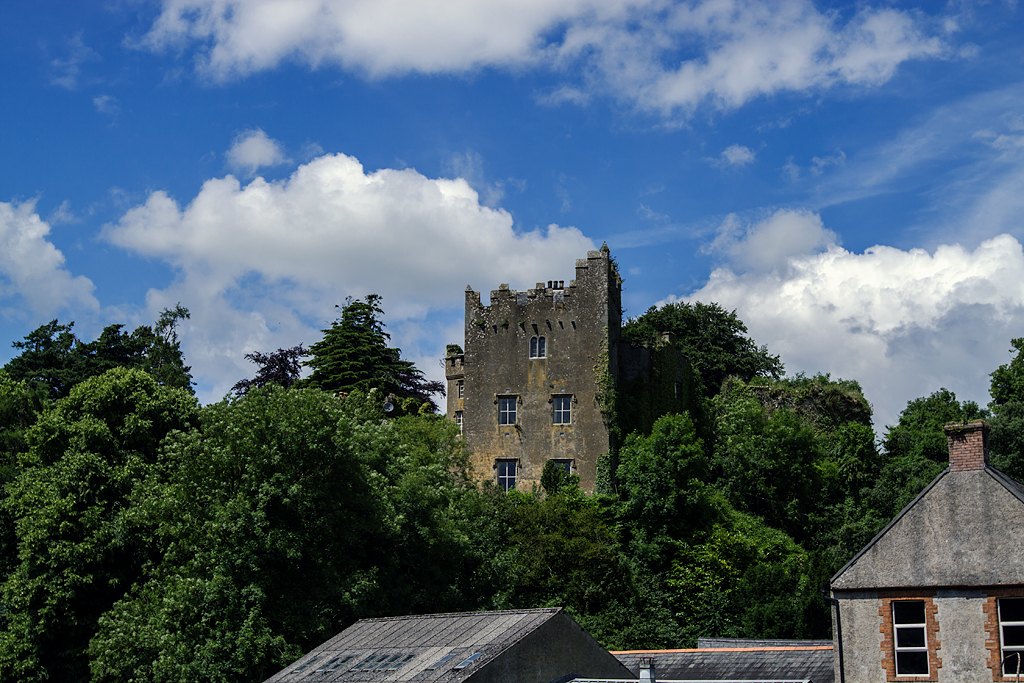
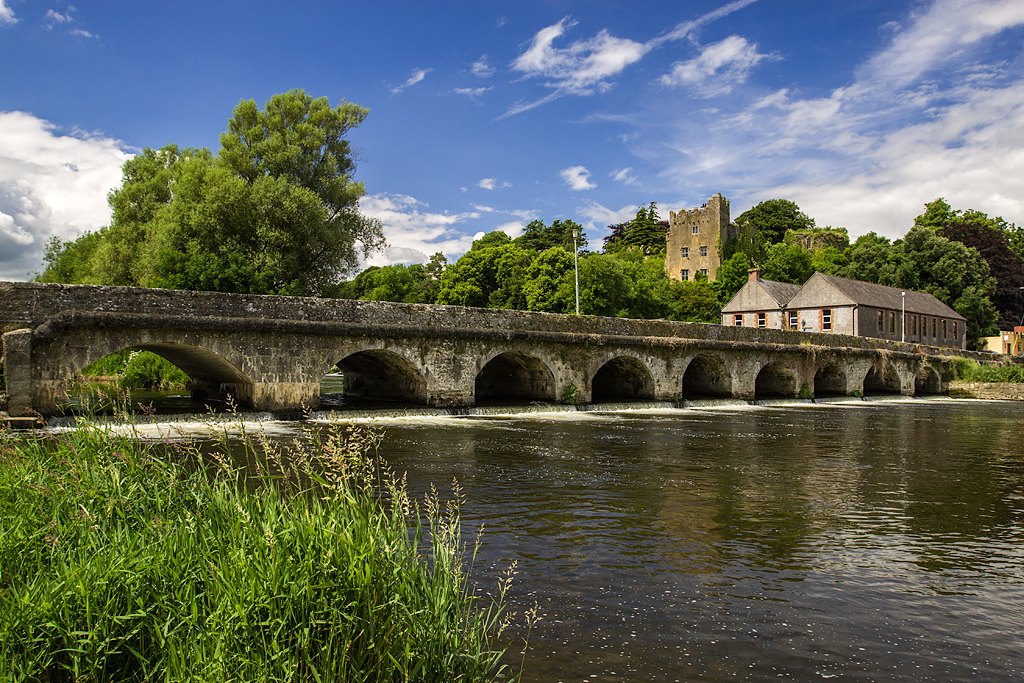
The castle is laid out as a parallelogram with a fortified gateway. At the eastern corners stand a keep and a circular tower, described as a 13th-century preceptory and noted as an uncommon shape in Ireland. To the west lie the ruins of two towers and a great hall. At the riverside, beside the bridge and road, is the old watermill. Mature trees in Castle Wood hide much of the building from the road, which is why the best views are the ones from the water’s edge.
The structure you see is a layered one. A restoration around 1846 added buildings and turned the tower-house into a country house, and a three-storey gabled wing was probably added in the 1930s.
Templars, Hospitallers and the late Middle Ages
The Knights Templar are linked with Ardfinnan, and the round tower is traditionally credited to them, though the sources are cautious about how early and how firmly. After the Templars were dissolved in 1312, their estates passed to the Knights Hospitaller, whose records for 1326 to 1339 list burgages and a church with tithes at Ardfinnan. The Hospitallers were dissolved in Ireland in 1540. We look at the evidence in The Knights Templar at Ardfinnan Castle.
The Cromwellian siege
Captain David Fitzgibbon, the “White Knight”, held the castle from 1649. In the Cromwellian campaign Major General Henry Ireton besieged it, bombarding the walls from a hill opposite after a failed attempt to cross the Suir by boat (Wikipedia dates the siege to 2 February 1650, though other accounts place the castle’s fall in 1649). Fitzgibbon surrendered; accounts differ on the length of the siege and the casualties. The New Model Army garrisoned the castle and, when the troops left, slighted it, leaving it partly in ruins. Fitzgibbon was spared but lost his lands and was transplanted west in 1653.
Garrison, family house and mill owner
The castle was garrisoned again from 1795 against the threat of French invasion, when a camp here held about 2,740 men by Wikipedia’s figures, and it was disbanded by 1802. In the nineteenth century it came back to a descendant of Maurice de Prendergast, and Admiral Sir Robert Prendergast was the last of that family to hold it. In 1921 John Mulcahy, owner of the Ardfinnan Woollen Mills, bought it. Restoration was complete by 1929, and mill workers found a Spanish helmet from the 1601 Siege of Kinsale.
Can you visit Ardfinnan Castle?
No, not inside. The castle and its grounds are a private home and are not open to the public. Please do not walk up to the gates or into the grounds. The good news is that the view that matters is public.
Where to see it
- From the bridge. Walk onto the long stone bridge over the Suir in the village. Looking along the river you see the castle on its rock, the weir and the old mill below. This is the classic view, and it costs nothing. Our guide to Ardfinnan Bridge explains what you are standing on.
- From the riverbank near the bridge, where the angle shows how the rock commands the crossing.
The bridge carries road traffic (a one-way light system was introduced in 2015 after structural damage was found), so take your photographs from a safe spot and do not stop in the carriageway. Ardfinnan is on the R665, 10 km from Cahir.
Why it matters
Few Irish castles have lasted from the first years of the Norman invasion to the present day with their setting nearly intact. Ardfinnan has the river, the bridge, the mill and the rock all in one frame, and it is lived in. That, rather than a ticket office, is its particular interest.