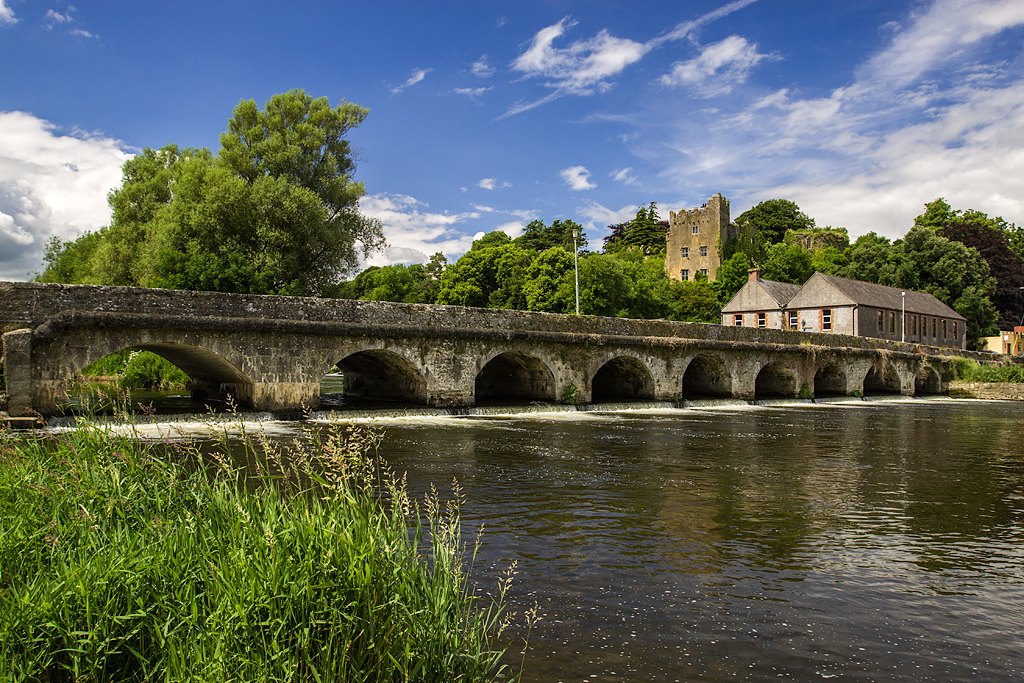
Cahir Castle and the Swiss Cottage: A Perfect Day from Ardfinnan
One fortress, one fantasy cottage and a ten-kilometre road between them make an unhurried day out.

The Office of Public Works looks after two very different buildings a short way from Ardfinnan. One is a castle that was built to withstand armies. The other was built to hold a picnic. Together they make one of the best days out in south Tipperary.
Cahir is about 10 km from Ardfinnan by the R670 (Wikipedia), and the Swiss Cottage lies on that same road, 2 km south of Cahir town (OPW). That makes the sequence easy: the cottage first, then the castle.
The Swiss Cottage
Begin on the Ardfinnan road. The cottage was built in the early 1800s for Richard Butler, 1st Earl of Glengall, and is attributed to the Regency architect John Nash. Wikipedia dates it to about 1810. It is a cottage orné: an idealised, ornamental version of a country cottage, meant for picnics, parties and hunting and fishing outings rather than for living in. The Butlers’ main house was nearby; the cottage was a retreat from it. It was originally just “The Cottage”, and the Swiss name probably came from a resemblance to an Alpine chalet.
What survives is charming and slightly absurd. A thatched roof, timber verandas, a timber spiral staircase and a parquet floor. Some rooms still have wallpapers attributed to the Paris firm Joseph Dufour and Company, reputedly among the first commercially produced Parisian wallpapers. After years of neglect, restoration began in 1985, overseen by the Irish Georgian Society, the Port Royal Foundation and the designer Sybil Connolly, and it opened as a museum in 1989. (Wikipedia)
Practical notes (from the OPW page):
- The interior is by guided tour only, on a first-come, first-served basis, with a maximum of 12 people per tour.
- Indoor photography is not permitted, and there is no lift.
- It is a seasonal site: the OPW lists it as open from 12 March to 4 November in 2026, with the last admission at 17:15. Check heritageireland.ie for current hours and admission.
Because tours are small and unbooked, go early in the day. In summer, expect to wait.
Cahir Castle
Then on to the castle, which the OPW describes as standing “proudly on a rocky island on the River Suir”. It was built in the thirteenth century and was the stronghold of the Butler family; Wikipedia records the castle being granted in 1375 to James Butler, Earl of Ormond, and enlarged and remodelled between the fifteenth and seventeenth centuries. (Wikipedia’s account of the earliest origins is inconsistent, so we do not date the first stone here.) At the time it was at the cutting edge of defensive design, and much of the original structure remains.
A short history of sieges
- 1599: The castle fell to the Earl of Essex after a three-day siege, the first time heavy artillery was used against it.
- 1647: It was surrendered to Lord Inchiquin after the Battle of Knocknanauss.
- 1650: Wikipedia records a surrender to Oliver Cromwell without a shot being fired.
- Late eighteenth century: it fell into ruin, and was partly restored in the 1840s.
- 1961 onward: after the Butler-Charteris estate was broken up, the State acquired the castle. It was declared a National Monument in 1964 and opened to the public in 1971.
What to see
Walk the outer courtyard first, then cross to the keep and the walls beside the river. The audio-visual show gives a clear account of the history, and guided tours are available. If the setting looks familiar, that is because the castle has been used in Excalibur, The Tudors and other productions.
Practical notes: the OPW lists Cahir Castle as open year round with seasonal hours, and lists a bookshop and guided tours. Bus groups must pre-book. Prices and hours change, so check heritageireland.ie before you go.
A sample day
- Leave Ardfinnan mid-morning and take the R670 north.
- Stop at the Swiss Cottage for the first tour you can get.
- Continue into Cahir for lunch.
- Spend the afternoon at the castle, ending with the audio-visual show.
- Return by the same road, or add Ardfinnan’s own bridge and castle view on the way home.
For the history of the castle you pass on the way back, read who built Ardfinnan Castle. For more of the area, see things to do near Ardfinnan, and for the bigger picture, the castles of Ireland.