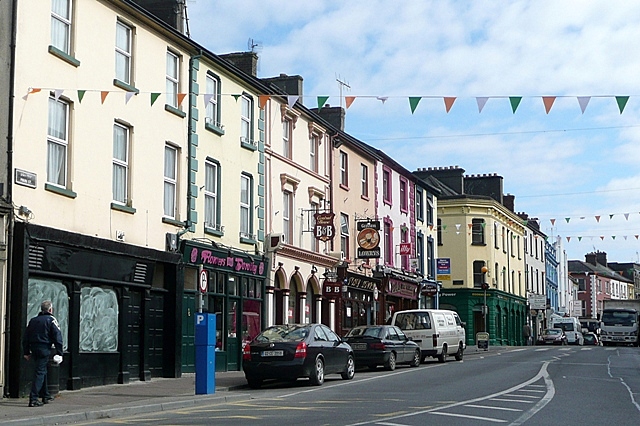
Clonmel, Co. Tipperary: Bianconi's Coaches, the West Gate and the Suir Quays
Clonmel, the honey meadow on the Suir, is Tipperary's largest town and the place where an Italian print-seller put Ireland on wheels.
Clonmel is the largest town in County Tipperary, with 18,369 residents at the 2022 census, and one of the county’s two county towns alongside Nenagh. It sits in the valley of the River Suir with the Comeragh Mountains to the south and Slievenamon to the north-east, in farmland known as the Golden Vale. The Irish name, Cluain Meala, means “honey meadow”. It is a working town rather than a museum piece, which is much of its appeal: the history is on the main street, between the shops.
Bianconi and Hearn’s Hotel
Clonmel’s best-known story belongs to Carlo Bianconi, born near Como in 1786, who anglicised his name to Charles after arriving in Ireland in 1802. He worked as an engraver and printseller, opened a shop in Carrick-on-Suir in 1806 and moved to Clonmel in 1815.
That year he began a passenger car service from Clonmel to Cahir. The journey by boat took five to eight hours; his carriage took about two. The date usually given for the first run is 6 July 1815, and local history sources place it outside what is now Hearn’s Hotel on Parnell Street. The building served as the Clonmel headquarters of his coaching business, with stables and workshops in the courtyard behind the carriageway. Sources differ on exactly when it became a hotel, so treat any single date with caution; a photo caption on Bianconi’s Wikipedia page notes the building is now called Bianconi House.
Bianconi twice served as mayor of Clonmel. By 1865 his annual income was about £35,000, and his services connected with several railway termini. He died on 22 September 1875, aged 88, at Longfield House in Boherlahan, Co. Tipperary.
The West Gate and the Main Guard
The town originally had North, East and West gates, with the south protected by the Suir and the Comeraghs. The West Gate you see today is a nineteenth-century reconstruction of an older structure, an open arch onto O’Connell Street, the main street. A small section of the town walls survives near Old St Mary’s Church, which was originally built in the fourteenth century or earlier and was fortified early on.
The Main Guard was a civic building until 1810, when it was converted into shops. It was once used as a tholsel, and some of its sandstone columns were reclaimed from the ruins of the Cistercian Inislounaght Abbey. Today it houses an exhibition on how the town developed, including a model of the thirteenth-century town.
Cromwell’s siege
In May 1650 Oliver Cromwell besieged Clonmel. The garrison commander, Hugh Dubh O’Neill, withdrew his forces at night, and the mayor, John White, surrendered the town on 18 May 1650. It is one of the best-known episodes in the story of Cromwell in Ireland; for the same period closer to home, see Cromwell at Ardfinnan.
Sterne and other names
Laurence Sterne, the author of Tristram Shandy (1713–68), was born in Clonmel, though his family returned to England soon after. Other people associated with the town include the novelist Anthony Trollope, who worked here for a period, Charles Kickham, whose 1873 novel Knocknagow drew on two Clonmel locals as models for characters, and Pat O’Callaghan, who won Olympic gold in 1928.
Things to do
- Walk the quays. The riverside along the Suir is the town’s classic view. The river was made navigable to Clonmel from 1760, and the quays were among the areas that flooded before flood defences were built.
- Tipperary Museum of Hidden History. It covers the county from the Stone Age to the present and was the first custom-built county museum in Ireland.
- Time it with a festival. The Clonmel Junction Festival runs for nine days from the first weekend of July; the International Film Festival Ireland has been held each September since 2009; there is a busking festival over four days in August.
- Shop and eat on the main streets. Opening hours and listings change, so check locally.
Getting there
The N24 links Limerick and Waterford through the town. Clonmel railway station opened on 1 May 1852, with two daily trains each to Waterford and to Limerick Junction and no Sunday service, according to Wikipedia. Check Irish Rail for current services before relying on rail travel.
Clonmel from Ardfinnan
Clonmel is about 14 km, or 15 to 20 minutes by road, from Ardfinnan, itself a Norman castle on the Suir worth seeing from the village bridge. The two are linked by the same river: the Suir that runs under Ardfinnan’s medieval multi-arch bridge flows on past Clonmel’s quays. For a wider day out, see things to do near Ardfinnan, or browse the attractions of Tipperary.
Frequently asked questions
What is Clonmel known for?
Clonmel is the largest town in County Tipperary, lying in the valley of the River Suir. It is known for Charles Bianconi's pioneering horse-drawn coach service, the 1650 siege by Oliver Cromwell, and as the birthplace of Laurence Sterne, author of Tristram Shandy.
What does Clonmel mean in Irish?
The Irish name is Cluain Meala, usually translated as 'honey meadow' or 'honey valley'.
How far is Clonmel from Ardfinnan?
About 14 km, roughly a 15 to 20 minute drive.
What is the Main Guard in Clonmel?
A former civic building that was converted to shops in 1810. It now houses an exhibition on the development of the town, including a model of the 13th-century town.