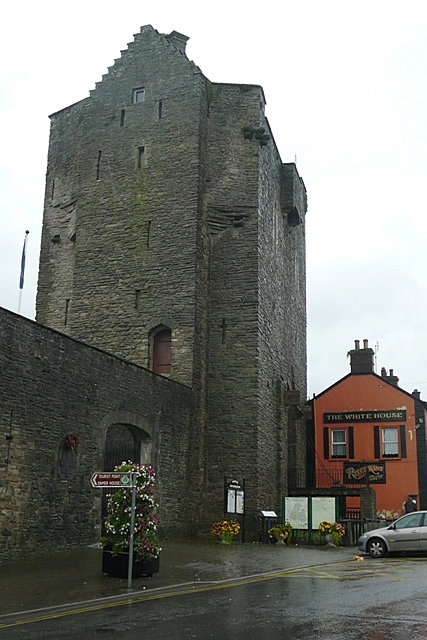
Loughmoe Castle, Templemore: The Purcell Tower House by the Railway
A gutted Purcell stronghold on flat ground between the River Suir and the main Dublin–Cork railway, glimpsed daily by passengers who rarely know its name.
Loughmoe Castle (Irish: Caisleán Luach Magh) is a ruined tower house and fortified manor in the village of Loughmore, about 5 km south of Templemore in County Tipperary. It was the main seat of the Purcell family, who lived in and around it for centuries, and it stands on flat ground between the River Suir and the Dublin–Cork railway, so travellers on the line can see it from the train. It is a roofless, gutted ruin that rewards a little background reading more than a long visit.
Where it stands
Loughmore lies a short drive from Templemore, and the castle sits in the fields beside the village. The Standing Stone places it “between the railway line and the river Suir”, and Wikipedia notes that it is visible to commuters on the Cork to Dublin line. This is not a castle on a rock or a hill. It is a low-ground stronghold, and its defences were built into the walls themselves rather than the landscape.
The Purcells of Loughmoe
The Purcells were an Anglo-Norman family. By the tradition recorded on Wikipedia, land at Loughmoe was granted to Sir Hugh Purcell in 1204 as part of the marriage settlement with Beatrix, daughter of Theobald FitzWalter. Wikipedia also records that James Butler, 1st Earl of Ormonde, made Richard Purcell Baron of Loughmoe in 1328. The title had no formal standing in the peerage, but later generations of the family used it, and the Purcells are usually described as the Barons of Loughmoe. Their ties with the Butlers ran through intermarriage.
Be a little careful with dates. Sources disagree about when the first tower went up. Wikipedia gives the 13th century for the oldest part, a four-storey tower house, while The Standing Stone calls the tower a 15th-century house with a 17th-century addition. The sources do not settle the question, so treat any single date with caution.
What was built
Two phases are easy to read on the ground, even in ruin:
- The tower house. The older block has rounded corners, gun loops and machicolations (projecting galleries from which defenders could drop missiles on attackers). The Standing Stone describes an elaborate fireplace on one floor carrying coats of arms and the initials of former residents.
- The fortified house. In the 17th century the Purcells added a large manor house alongside the tower. Together the two give the building the shape of an “H plan house”, in The Standing Stone’s phrase. This later portion is now gutted, with its floors gone.
The roof of the tower is missing too, and the upper level is overgrown. What remains is a shell of great thickness, which is exactly why it has survived.
Folklore
Local legend says a Purcell won the castle, its lands and the hand of a king’s daughter by killing a wild boar and sow that had terrorised the parish. Wikipedia retells the story as folklore, and that is how to take it. Two scholarly papers from 1909, by Henry S. Crawford and John D. Seymour, are cited there for the castle’s ruins and legends.
The last Purcells
The Purcells sided with James II in the Williamite War. The Standing Stone notes that Nicholas Purcell fought at Aughrim and signed the Treaty of Limerick in 1691. Unlike many Jacobites, he did not leave Ireland afterwards and stayed to campaign for Catholic rights. Wikipedia gives his death as 4 March 1722, and says the family lived at the castle until around 1760, although that last point is not firmly sourced and other accounts differ.
Visiting Loughmoe Castle
There is no ticketed visitor centre, and nothing in the sources we read gives opening hours. According to one visitor’s account, access is through a farmyard, and the author advises asking the owner first. Treat that as background rather than a current instruction, since access arrangements can change, and check locally before you go.
The same account describes a dangerous interior: rubble and weeds, dark narrow stairs, a missing basement floor, fallen masonry on the top floor and a hidden chamber entered by dropping down from above. Do not climb on or enter unsafe parts. From outside, with the railway and river in the frame, the castle is photogenic enough. If you are driving, the village is the starting point.
From Ardfinnan
Loughmoe is roughly 55 km by road from Ardfinnan, about an hour’s drive. That is further than most of the other castles in the county, but it makes a natural counterpoint. Ardfinnan is a Norman castle on a rock above the Suir, still lived in and best seen from its village bridge. Loughmoe is a Norman-descended family’s seat left to fall into ruin on the same river’s upper reaches. For the wider picture, see Castles of Tipperary.
Frequently asked questions
Where is Loughmoe Castle?
In Loughmore (also spelt Loughmoe) village, about 5 km south of Templemore in County Tipperary. It stands between the railway line and the River Suir.
Who built Loughmoe Castle?
It was the seat of the Purcell family. The earliest tower is dated variously from the 13th to the 15th century depending on the source, and the Purcells added a large fortified house in the 17th century.
Can you go inside Loughmoe Castle?
It is a ruin reached through a farmyard, and one visitor's account advises asking permission and taking care because floors and stairs are in poor condition. Check locally before going and do not enter anywhere unsafe.
How far is Loughmoe Castle from Ardfinnan?
Roughly 55 km by road, a drive of about an hour, so it suits a day out through north Tipperary rather than a quick detour.