Amazing Places to Visit in Ireland: A Traveller's Shortlist
Fourteen places, from a 5,000-year-old tomb to a rock on the Tipperary plain, that earn their reputation.

Any list of amazing places to visit in Ireland is an argument, and this one makes no claim to be final. It is a shortlist: places that are old, or wild, or both, and that repay the journey. Most are famous for good reason. A few sit quietly in the south-east, within reach of Ardfinnan, and deserve to be named in the same breath.
The headline acts
1. Newgrange, County Meath
A passage tomb on a rise above the River Boyne, part of the Brú na Bóinne complex that UNESCO listed in 1993. The mound is roughly 85 m wide and 12 m high, and a passage about 19 m long leads to a chamber with a corbelled roof. Its famous trick: at the winter solstice the rising sun shines down the passage and lights the chamber for around 17 minutes. Dating is debated, but the usual estimate of about 3100 BC makes it older than the present Stonehenge. Entry is by guided tour from the Brú na Bóinne Visitor Centre. (Wikipedia)
2. Skellig Michael, County Kerry
A pinnacle of rock about 11.6 km off the Iveragh Peninsula, where monks lived from somewhere between the sixth and eighth centuries until the late twelfth or early thirteenth. Six dry-stone beehive cells survive, reached by around 600 stone steps. It became a World Heritage Site in 1996 and the Office of Public Works caps landings at 180 people a day, in summer only. Book early, and expect the sea to have the final say. (Wikipedia)
3. The Cliffs of Moher, County Clare
About 14 km of sea cliffs, reaching 214 m just north of O’Brien’s Tower, which Sir Cornelius O’Brien built in 1835. The rock is shale and sandstone laid down over 300 million years ago. They are busy, with over a million visitors a year, so go early or late. (Wikipedia)
4. The Burren, County Clare
A bare limestone country of about 250 km² of exposed rock, laid down in a tropical sea some 325 million years ago and scoured by glaciers. Arctic-alpine and Mediterranean plants grow side by side, and the region holds over 70% of Ireland’s flower species. Neolithic tombs, including the Poulnabrone dolmen, sit among the grikes and clints. (Wikipedia)
5. Giant’s Causeway, County Antrim
Around 40,000 interlocking basalt columns, mostly hexagonal and up to about 12 m tall, formed 50 to 60 million years ago. A World Heritage Site since 1986, it is in Northern Ireland, near Bushmills, and is owned and managed largely by the National Trust. The legend has Fionn mac Cumhaill building the causeway to reach a Scottish rival. (Wikipedia)
6. Glendalough, County Wicklow
Gleann Dá Loch, the valley of two lakes. St Kevin founded a monastery here in the sixth century, and the settlement flourished for about six hundred years. The monastic city has a gateway, a cathedral, several churches and a round tower about 30 m high, all within Wicklow Mountains National Park, which maintains nine waymarked trails. (Wikipedia)
7. Clonmacnoise, County Offaly
St Ciarán founded this monastery on the Shannon in 544. It grew into a centre of learning and trade between the eighth and twelfth centuries and was finally destroyed by an English garrison in 1552. Two round towers and three high crosses remain, and Temple Ciarán, built in 909, is considered the oldest dated stone church surviving in Ireland. (Wikipedia)
8. Dún Aonghasa, Inis Mór, County Galway
A prehistoric stone fort on the Aran Islands, set on the edge of a cliff roughly 100 m high. Excavations suggest construction began around 1100 BC. Four concentric walls enclose about six hectares, and a field of upright limestone spikes, a cheval de frise, still guards the approach. (Wikipedia)
9. Slieve League, County Donegal
Sliabh Liag rises to 601 m on the Atlantic coast and has some of the highest sea cliffs in Europe. The ridge walk called One Man’s Path was described by the naturalist Robert Lloyd Praeger as one of the most remarkable in Ireland. (Wikipedia)
The south-east belongs on the list
The Atlantic coast gets the postcards. The Suir Valley gets fewer visitors, and arguably tells the story of Ireland better, because the seat of Munster’s kings, Norman castles, and the Regency fantasy of the Swiss Cottage all stand within an hour’s drive of each other.
10. The Rock of Cashel, County Tipperary
A limestone outcrop on the Golden Vale carrying a round tower, a high cross, a Romanesque chapel, a Gothic cathedral and a fifteenth-century tower house. It was a seat of the kings of Munster; Brian Boru was proclaimed King of Munster here in the late tenth century (he became High King of Ireland in 1002); and in 1101 the site passed to the church. Cormac’s Chapel holds the only surviving Romanesque frescoes in Ireland. Allow an hour to an hour and a half, and wear sturdy shoes: the site is exposed, and low doorways and uneven paths come with the territory. (Heritage Ireland)
11. Cahir Castle, County Tipperary
Built in the thirteenth century on a rocky island in the River Suir, home to the Butler family, and at its time cutting-edge defensive design. It was reckoned nearly impregnable, yet fell to the Earl of Essex in 1599 when heavy artillery was used against it for the first time. Much of the original structure survives, and it has been a filming location for Excalibur and The Tudors. See our Cahir Castle and Swiss Cottage day trip. (Heritage Ireland)
12. The Knockmealdown Mountains, Tipperary and Waterford
A range along the county border, topped by Knockmealdown at 794 m. The Vee is a high pass where the old mail-coach road runs between Lismore and Clogheen, and the uplands are breeding ground for red grouse and hen harriers. It is the nearest real mountain country to Ardfinnan. (Wikipedia)
13. Ardfinnan, County Tipperary
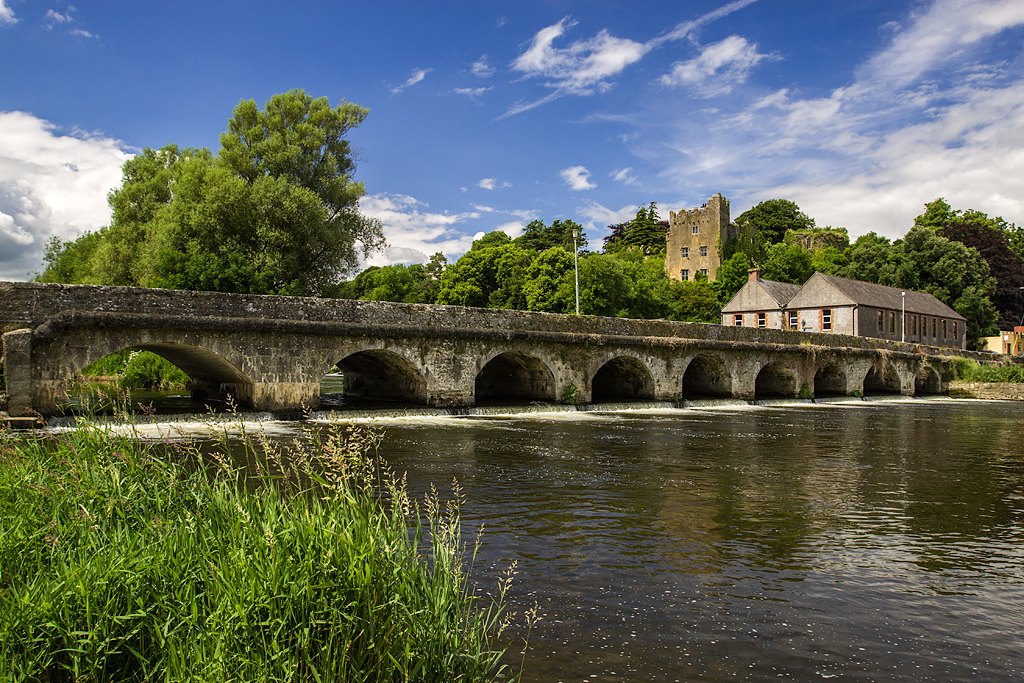
Our own patch: a village on the Suir whose 14-arch bridge sits below a castle that tradition and Wikipedia credit to Prince John in 1185 (it is a private home today and not open to visitors). The name, Ard Fhíonáin, is older still, tied to an early saint. Start with the village’s castle story and the wider tradition of Irish castles. (Wikipedia)
14. Mitchelstown Cave, County Tipperary
Found by accident on 3 May 1833 by Michael Condon while he was quarrying limestone, and open to guided tours ever since. Its chambers and passages include a vast cavern, Tír na Nóg, and a column known as the Tower of Babel. Entry is by booking, and it is about twenty minutes from the Rock of Cashel. (Mitchelstown Cave)
How to use this list
Ireland is small, but the roads are not fast. Pick a region, not a list. A week in the south-east could take in Cashel, Cahir, the Knockmealdowns and the cave without a long drive between them; a week in the west would be Clare, the Burren and Aran. For more on the south-east, read our guide to things to do near Ardfinnan.
Opening times and prices change, and several of these sites close or restrict access in bad weather. Always check the official page before you travel.