Burncourt Castle, Clogheen: The Burned Court of Sir Richard Everard
A grand fortified house raised just before the 1641 rising, and left a ruin when its owner's wife set it alight.

Burncourt Castle is the ruin of a large fortified house near Clogheen in south Tipperary, built by Sir Richard Everard just before the 1641 rebellion and burned during the Cromwellian wars. Its Irish name is An Chúirt Dóite, “the burned court”. It is a national monument in private ownership, and it stands about 15 km from Ardfinnan, among the foothills of the Galtee Mountains. Because it is a ruin on private land, view it from the road and do not go into the fields without permission.
Everard’s house
The Everards were an old Catholic family, said to have come to Ireland about 1177, and effective owners of Fethard from the 15th century. Sir Richard’s father, Sir John Everard, was a judge who resigned rather than take the Oath of Allegiance and, in 1613, sat in the Speaker’s chair to block the government’s candidate.
Sir Richard began the house around 1639, according to Wikipedia, and Bence-Jones’s guide, quoted by Irish Historic Houses, says building started from 1640. A stone that was once over the entrance bore 1641, presumably the year of completion. The Irish Aesthete places it near Clogheen between the Galtees and the town.
What you can see
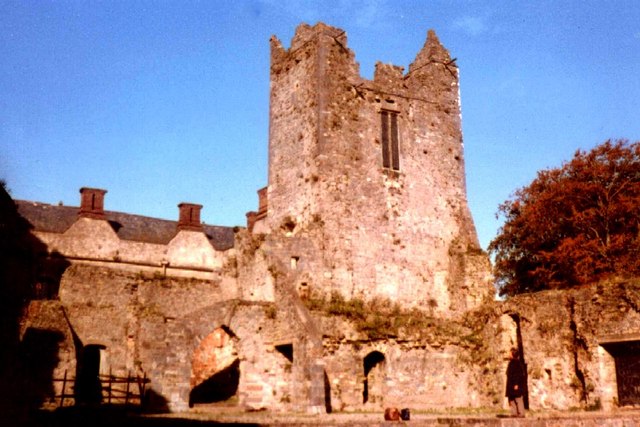
It looks more like an English manor house than an Irish tower house. The Irish Aesthete names it as the last of a group of semi-fortified houses that includes Rathfarnham, Kanturk, Leamaneagh and Portumna.
- a central block of four bays, with four-storey square corner towers
- 26 gables and seven chimney stacks, in the figures given by Wikipedia and the Irish Aesthete
- deep corbels along the front, meant to carry a wooden gallery
- a low front door, placed off-centre, with a finer cut-stone doorcase and a hood mould
- many mullioned and transomed windows, which made the house lighter than a traditional castle
Part of the bawn, including a corner turret, survives nearby. The cellar floor is cobbled with irregular stones.
Burned, not stormed
Richard Everard sided with the Catholic Confederates. He sat at Kilkenny, and was a leader against Cromwell’s army. He was hanged by Henry Ireton in 1651 after the surrender of Limerick.
As Cromwell’s army advanced, Lady Everard set the house on fire rather than let it fall to the enemy. The date is given as 1649 by Wikipedia and 1650 by the Irish Aesthete and other accounts. Bence-Jones says the house was still unfinished. Whichever is right, it was never restored. After the 1660 Restoration the lands passed to Richard’s eldest son, but the family’s presence in the area ended with the death of Sir Redmond Everard about 1740.
An excavation noted by Wikipedia found no burnt debris, which suggests that the roof slates and lead were salvaged or looted. Around the early 18th century the painter Anthony Chearnley built a house in front of the ruin; its remains now serve as farm buildings.
After the Everards
After Sir Richard’s death the family forfeited its lands. They were restored to his eldest son, Sir Redmond Everard, after 1660. The Irish Aesthete adds that a later Sir John Everard was attainted for supporting James II, and that in 1751 the Burncourt area went to a Dublin lawyer, Cornelius O’Callaghan. His great-grandson, later 1st Viscount Lismore, built Shanbally Castle nearby, designed by John Nash and demolished by the Irish Land Commission in 1960. The ruin outlasted it.
Seven years, seven days
A local tradition says the house took seven years to build, was lived in for seven years, and took seven days to burn. Treat it as a story, not a record. The first part sits oddly beside the dates, since construction seems to have run from about 1639 or 1640 to 1641. Note too that “seven” is the number of chimney stacks, not gables: there were 26 of those. The saying is repeated in both Wikipedia and the Irish Aesthete.
From Ardfinnan
Burncourt is about 15 km from Ardfinnan, roughly 20 minutes by road, with Clogheen on the way. Ardfinnan Castle is much older, begun in 1185, and is still lived in. Visit both and you see two ends of Tipperary’s castle story: a Norman fortress that has never stopped being a home, and a fortified house of the 1640s that was lost within a few years of its completion. See also Cromwell at Ardfinnan and the Tipperary castles hub.
Frequently asked questions
Who built Burncourt Castle?
Sir Richard Everard, 1st Baronet, built it in the years before the 1641 rebellion. A stone once over the entrance carried the date 1641, presumably the year the work was completed.
How did Burncourt Castle become a ruin?
Tradition and the standard accounts say Lady Everard set the house on fire rather than let Cromwell's advancing army take it. Wikipedia places this in 1649, while Bence-Jones and other sources say 1650. It was never restored.
What is the 'seven years' saying about Burncourt?
Legend says the house took seven years to build, was lived in for seven years and took seven days to burn. It is a tradition, not a documented fact.