A Short History of Ardfinnan, County Tipperary
A monastery, a castle, a long stone bridge and a woollen mill: eight centuries of Irish history have been laid down in one bend of the River Suir.
Ardfinnan is a small village on the River Suir in south County Tipperary, with a population of 978 at the 2022 census. Its history is much larger than that figure suggests. The place has had a church, a castle, a bridge and a mill on the same short stretch of river, and each has left something behind.
The name and the saint
The Irish name is Ard Fhíonáin, usually rendered “Fíonán’s height” or “the high place of Finnian”. The saint is traditionally taken to be Fíonán Lobhar (Finian the Leper), who is said to have founded an abbey here in the sixth century. An older name, Ard Brennuin, is also recorded. Our separate article on the meaning of the name Ardfinnan goes into the language, and a companion piece looks at the saint himself.
Another saint is firmly tied to the place. Mochuda (Carthage) of Lismore and his monks are said to have settled cells at Ardfinnan in the seventh century, on the pilgrim road between Cashel and Ardmore. The crossing of the Suir here made the site a natural stopping point.
Early records are thin but real. Wikipedia, drawing on the annals, notes that Cormac mac Cuilennáin, King of Munster, left gifts to Ardfinnan Abbey in 908, and that the death of a prior named Giola is recorded in 1085.
The Norman castle
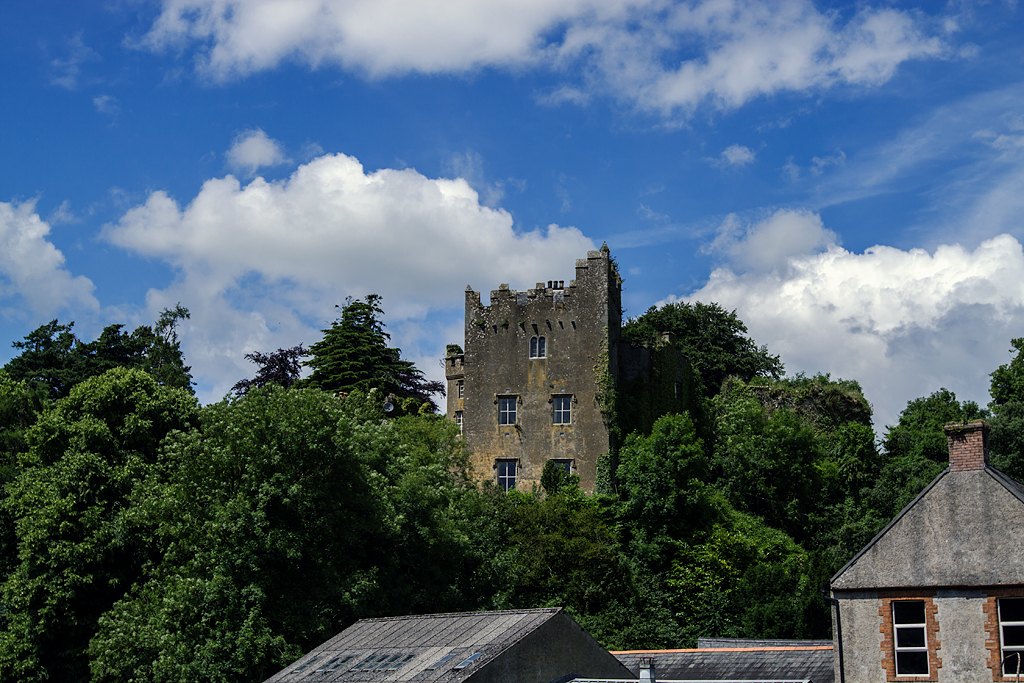
In 1185 Prince John, then about eighteen and newly styled Lord of Ireland, had a castle raised on the rock above the river, on the site of the former abbey. Henry II had planned castles at Ardfinnan and Lismore to guard the northern border of Waterford. Maurice de Prendergast is named as its first governor, and the castle was soon taken by forces under Donal O’Brien, which tells you how contested the frontier was. The full story is in Who Built Ardfinnan Castle?.
Afterwards the Knights Templar probably managed the property, and on their dissolution in 1312 it passed to the Hospitallers. A record from 1295 names a dyer, William, in the medieval village, a first hint of the cloth trade that would define Ardfinnan much later. In 1449 an act of the Irish Parliament exempted the town from certain customs and sanctions.
The bridge
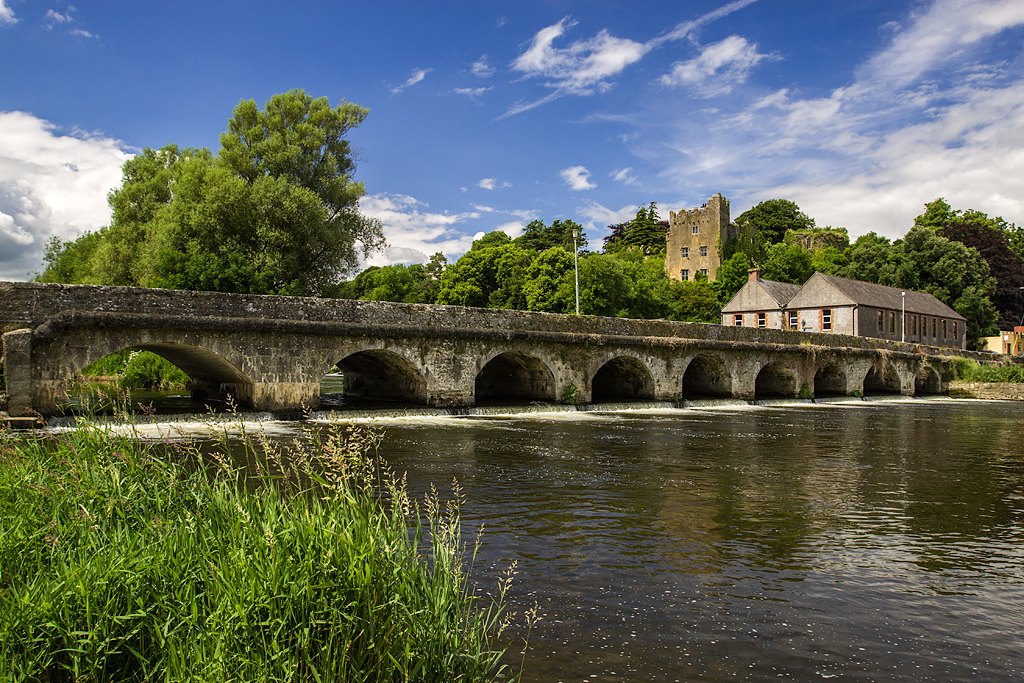
Below the castle runs the long multi-arch bridge over the Suir. The Irish Penny Journal of 1841 called it “a long and level bridge of fourteen arches, which tradition states is of coeval erection with the fortress”, and added that it was in any case “of very great antiquity”. The National Inventory of Architectural Heritage records the present bridge as having thirteen arches and being rebuilt around 1800; the tradition of a medieval origin is only that. Either way, a crossing has carried the road over the Suir here for a very long time.
Age has a price. After structural damage was found, a one-way traffic-light system was introduced on the bridge at the end of 2015, and in January 2017 €800,000 was allocated for remedial works. The castle, bridge and adjoining watermill are all protected structures.
War and settlement
The seventeenth century was hard on the Suir valley. The castle was held in 1649 by Captain David Fitzgibbon, and was besieged and slighted by Parliamentarian forces; sources disagree on the exact date, as we explain in Cromwell and the Suir Valley. Fitzgibbon lost his lands and was transplanted west in 1653. By the 1654 survey the manor, with its castle, mill and weir, was recorded as held by the Bishop of Lismore and Waterford.
Later the castle saw a very different kind of occupant: between 1795 and 1802, during the wars with revolutionary France, British fencible regiments camped here, with about 2,740 soldiers ordered into a permanent camp in March 1796. By about 1846 the tower-house had been restored as a country house by the Prendergast family.
The Famine years
Ardfinnan was one of the electoral divisions of the Clogheen Poor Law Union, declared on 2 February 1839. Its workhouse, built for 500 inmates at a cost of £5,230, took its first paupers on 29 June 1842. During the Famine years, store sheds there were adapted to hold eighty fever patients, and the infirmary was later extended.
We have not found reliable parish-level figures for Ardfinnan itself, so we will not guess at them. Wikipedia records that the Countess of Donoughmore set up an annual clothing market, the Ardfinnan Clothing Club, in the aftermath, which gives a sense of how the community tried to cope.
Mills and the modern village
The Suir that once powered Templar mills powered Ardfinnan’s next chapter. In the mid-nineteenth century the Quaker James Fennell leased the watermill as a gristmill. The Ardfinnan Woollen Mills, owned by John Mulcahy by 1921, employed up to 300 people at their height and received a visit from Edward VII in 1904. They closed in 1973. John Mulcahy also bought the castle in 1921, and carried out restoration there in 1929.
Industry did not end with the wool. Atari made wooden arcade cabinets in the village from 1974 to 1984, with up to 200 workers at its peak, and an insulation plant operated from 1974 until 2008.
Ardfinnan today
What remains is a quiet village whose landmarks still explain themselves: the castle above, the bridge below, and the river between. The castle is a private home, so the best view is from the bridge itself, looking up. It is the same view that has drawn travellers for centuries.