The Ardfinnan Woollen Mills: The Mill That Clothed the Suir Valley
For roughly a century a mill at the foot of the castle rock turned Suir water into tweed, and made a small Tipperary village known to tailors far beyond Ireland.
The Ardfinnan Woollen Mills, trading as Mulcahy, Redmond & Co., were a leading Irish textile firm and a major local employer. Wikipedia dates the firm to 1869 and records that its workforce was let go in January 1973. In between, the mill made cloth for tailors, for the British War Office and for an airline, put electric light in village houses, and gave a young football club many of its players.
A mill beside a castle and a bridge
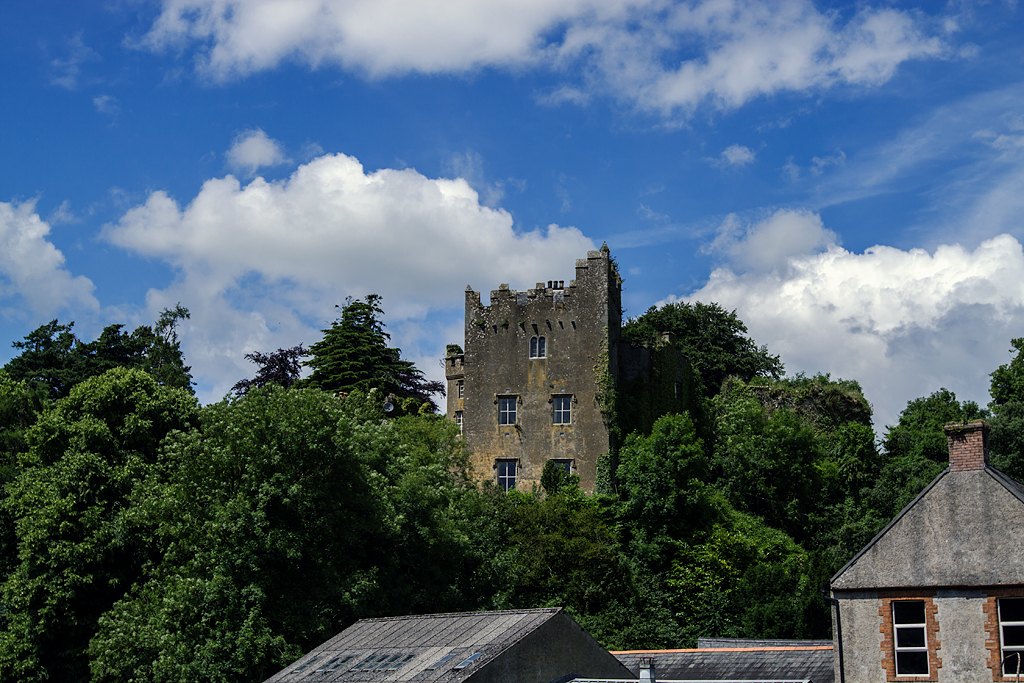
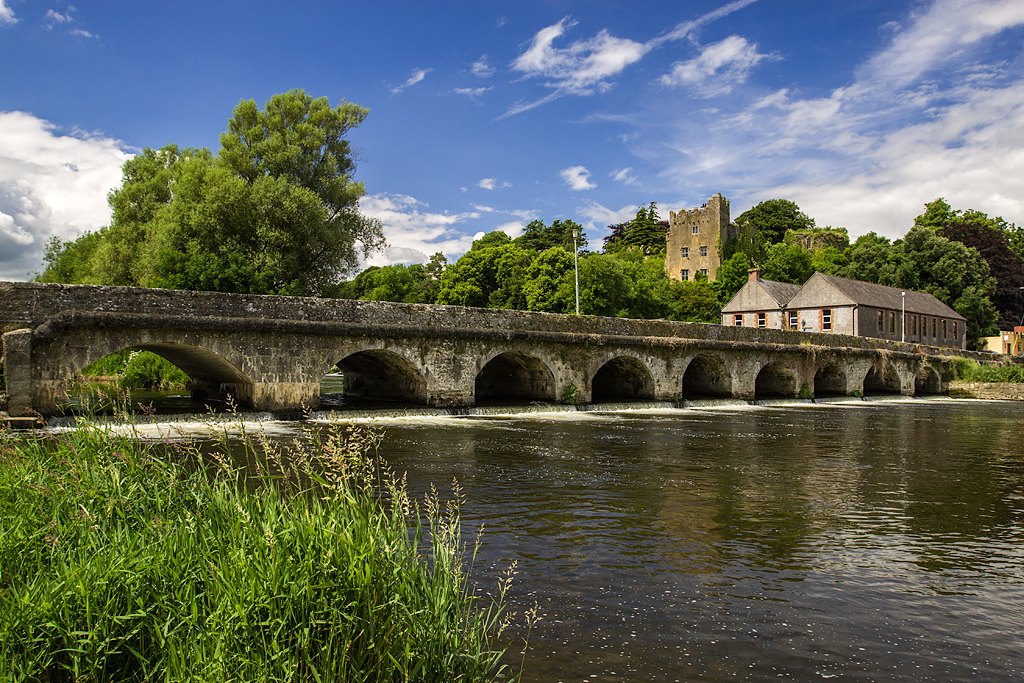
A mill stood here long before the woollen firm. The National Inventory of Architectural Heritage (NIAH) notes that a grist mill is mentioned in the Civil Survey as early as the mid-seventeenth century, and the Wikipedia article on Ardfinnan Castle quotes the 1654 survey describing the manor as “castle, mill and weir”. The mill sits so close to the bridge over the Suir that, in the NIAH’s words, “the mill race flows under its parapet wall”.
Popular accounts trace wool-working here to the Knights Templar. Wikipedia’s village article says they are believed to have controlled woollen production, and it records a miller named William in the medieval village in 1295. There is no firm documentary chain from the Middle Ages to the nineteenth-century factory, so treat the Templar link as tradition. Our piece on the Templars and the castle sets out what is and is not known.
The Mulcahy years
Wikipedia’s article on the firm says that in 1869 John and Mary Mulcahy revived the “Ardfinnan woollen factory” from the Mill House below the castle. The village article adds that the watermill had been leased in the mid-nineteenth century to a Quaker, James Fennell, as a gristmill, and that other operators, including W. Schofield of Dublin and John Hogan Burke & Co. of Cahir, leased the mills in 1865.
Fire was a constant risk in a wool mill. The NIAH records that a three-storey mill on the site was burnt down in the nineteenth century and rebuilt as a two-storey building; it dates the present mill to about 1895. Wikipedia’s mills article places a fire in 1883, affecting 50 to 100 workers. These may be the same event, but the sources do not say so, and we will not link them ourselves.
What the mill made is well documented in Wikipedia’s account:
- Irish tweeds, friezes, blankets, shawls and railway rugs.
- Galtee Motor Cloth, patented by Frank Mulcahy in 1906 and described there as a warm cloth for motoring coats and rugs.
- Khaki serge, frieze and blankets for the British War Office in the First World War.
- Cloth for Aer Lingus uniforms, with the first made in 1945, according to the same article.
- A ready-made clothing line from 1947, which added more than 70 workers.
The article calls the firm the only factory on the island completing every stage from fleece to finished clothing. That is a claim made by the article’s sources rather than something we have independently checked, so we repeat it with that caution.
A royal visit and electric light
In 1904, Wikipedia records, Edward VII, Queen Alexandra and Princess Victoria visited the mills during a private motor tour of Ireland. Two years later, it says, the king ordered Galtee Motor Cloth for a coat.
The river did more than drive looms. The village article says the firm supplied electricity and gas for streetlights and homes in the surrounding area “long before rural electrification”. The mills article puts hydro-electric supply and carbide lamps in the 1900s, with the ESB taking over the supply in January 1953. For the national scheme that followed, see Ardfinnan in the twentieth century.
The mill and the football club
Ardfinnan GAA was formed in 1910. Wikipedia’s article on the club says the Woollen Mills had a big influence on it because many players worked there. The mills article goes further and says the mill’s football team founded the club; we cannot confirm that from a second source, so the safer statement is the influence. For the club’s own story, read the history of Ardfinnan GAA. A workplace supplying a team is common in Irish industrial villages, but here it is documented only briefly.
Decline and closure
The 1970s were hard for Irish textiles. Wikipedia’s mills article reports that the firm let go its workforce in January 1973, blaming competitive disadvantages including Ireland’s admission to the EEC. It adds that workers and members of the Mulcahy family protested in Clonmel after promises to protect the woollen industry were not kept. We have found no more detailed account of the closure, and no full employment record.
The village did not stand still. According to the village article, Atari built wooden arcade cabinets nearby from 1974 to 1984, with up to 200 workers, and an insulation plant ran from 1974 to 2008.
What remains
The NIAH lists the former mill as a building of regional importance, disused, with a distinctive M-profile roofline and moulded brick. Wikipedia notes the castle, bridge and watermill as protected structures, and that workers’ cottages still stand in the village. John Mulcahy bought the castle itself in 1921, according to the castle article, and further restoration followed by 1929.
The best view of the old mill is from the bridge, with the castle on its rock above. For the full sweep of the village, start with the history of Ardfinnan, and for the river that powered all of it, read the River Suir at Ardfinnan.
Frequently asked questions
When did the Ardfinnan Woollen Mills close?
Wikipedia gives 1973 as the closing year; its article on the firm says the workforce was let go in January 1973, with competitive disadvantages, including Ireland's entry to the EEC, blamed.
Who owned the Ardfinnan Woollen Mills?
The firm traded as Mulcahy, Redmond & Co. and was a Mulcahy family business. Wikipedia says John and Mary Mulcahy revived it from March 1869 from the Mill House below Ardfinnan Castle.
Did a king visit the Ardfinnan Woollen Mills?
Yes. Wikipedia records that Edward VII visited the mills in 1904, during a motor tour of Ireland.
How many people worked at the Ardfinnan Woollen Mills?
Wikipedia's village article says as many as 300 workers at its peak. Its article on the mills gives a figure that later exceeded 300 and notes that up to 500 people depended on the mills, directly or indirectly. Treat these as approximate.